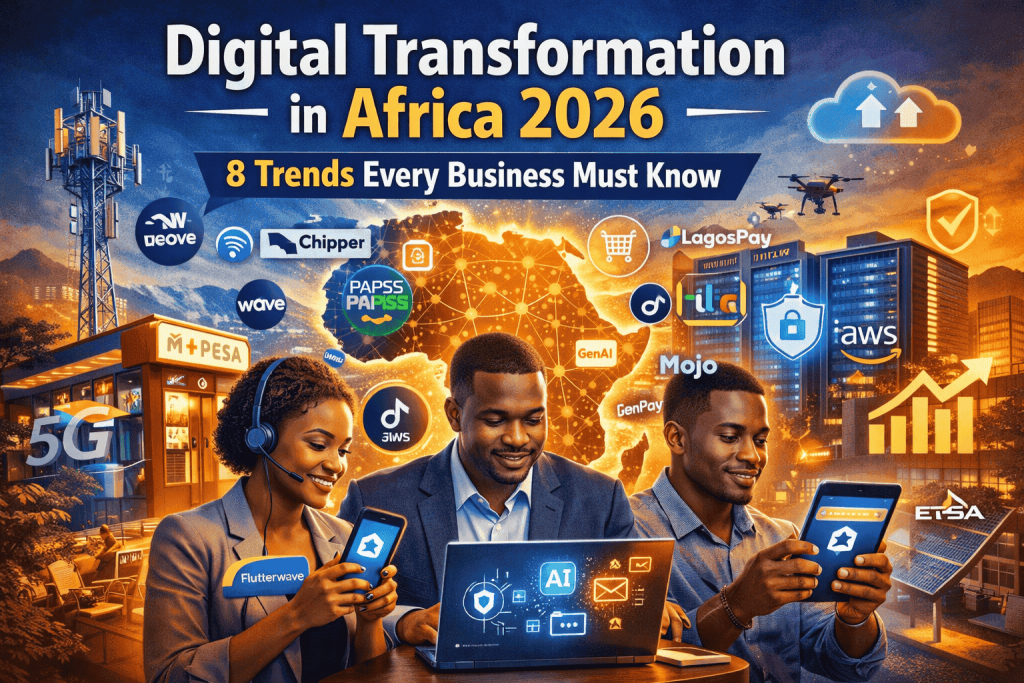
Digital Transformation in Africa 2026: 8 Trends Every Business Must Know
Introduction
Digital transformation in Africa in 2026 is no longer a future ambition. It is the present reality for businesses that want to survive and grow. With over 600 million internet users across the continent, a median population age of under 20, and some of the world’s fastest growing startup ecosystems, African businesses are not just catching up to global digital trends. In many areas, they are setting them.
If you have been following how African businesses performed digitally in 2025, you will recognise that the trends below are not sudden shifts. They are the natural next chapter of a transformation already well underway. Whether your business is just beginning its digital journey or scaling an existing operation, understanding what is happening across the continent in 2026 is essential.
1. Digital Transformation in Africa 2026 Starts With Mobile AI
Mobile has always been the dominant access point for African consumers and businesses alike. In 2026, that reality is supercharged by the integration of artificial intelligence directly into mobile experiences. From AI driven customer service chatbots in local languages to smart inventory management tools for small traders, AI is no longer the preserve of large corporations.
Startups and SMEs across Nigeria, Kenya, Ghana, and South Africa are deploying lightweight AI tools designed to work on low bandwidth connections. Platforms like M-Pesa have shown the world what mobile native financial services can look like. Now that blueprint is being extended into healthcare, agriculture, retail, and logistics. Businesses that have not yet integrated AI into their mobile customer touchpoints are already falling behind.
This is especially relevant for businesses that are only just beginning to go digital. Starting with a mobile first strategy in 2026 means building with AI capability from day one rather than retrofitting it later.
2. Homegrown Fintech Is Reshaping African Business Infrastructure

For years, African fintech depended heavily on foreign payment rails and international banking relationships. 2026 marks a meaningful shift. Pan African payment infrastructure built by African companies for African realities is maturing rapidly. The rollout of the Pan African Payment and Settlement System (PAPSS) continues to reduce the friction of cross border trade, opening payment corridors between African markets that previously required routing through London or New York.
For businesses, this means lower transaction costs, faster settlement, and less exposure to foreign exchange volatility. Entrepreneurs operating across multiple African countries should be actively evaluating whether their payment stack takes full advantage of these new rails.
3. Generative AI Is Now a Core Business Tool Across Africa

Generative AI has moved decisively from curiosity to core utility. Digital transformation in Africa in 2026 is being driven in no small part by the democratisation of AI tools that were once accessible only to well funded companies. African businesses are finding particularly strong use cases in content localisation, legal and compliance document drafting, and customer engagement automation.
A small business in Nairobi or Accra can now access capabilities including content creation, data analysis, and round the clock customer support that previously required teams of specialists. The businesses winning in 2026 are those treating generative AI as a productivity multiplier rather than a threat.
To make the most of these tools, businesses need a solid digital foundation to begin with. If you are not yet sure where to start, our guide to free digital tools every African SME should use is a practical first step.
4. eCommerce Is Maturing and Social Commerce Is Dominant

African eCommerce is entering a more mature phase. The explosive growth years of the early 2020s produced hard lessons about logistics, last mile delivery, and consumer trust. In 2026, the businesses that absorbed those lessons are leaner, smarter, and better positioned.
Social commerce, which means selling directly through WhatsApp, TikTok, Instagram, and increasingly through African built platforms, is now a primary channel rather than a supplementary one. In markets where formal eCommerce platforms continue to struggle with logistics infrastructure, social commerce offers a flexible and relationship driven alternative.
Trust remains the central currency of online commerce. If your business is still working to strengthen its credibility online, the principles in our guide on how to build trust online for African businesses are more relevant than ever in 2026.
5. Cloud Adoption Is Accelerating as African Data Centres Expand

For African businesses, cloud adoption has historically come with latency and data sovereignty concerns. That is changing. Major hyperscalers alongside regional players have significantly expanded their African infrastructure footprint, with data centres now operating or under construction in South Africa, Kenya, Nigeria, Egypt, and beyond.
This local infrastructure matters enormously for regulated industries such as banking, healthcare, and government services, where data residency requirements had previously limited cloud adoption. In 2026, cloud migration for African enterprises is accelerating in a way we have not seen before, unlocking meaningful gains in productivity, scalability, and security.
Understanding where your data lives starts with understanding your hosting environment. Our guide on web hosting basics for African businesses is a useful place to begin before making infrastructure decisions.
6. Cybersecurity Is Now a Board Level Priority

As African businesses digitise, they have become more attractive targets for cybercriminals. Ransomware attacks, business email compromise, and mobile fraud have all increased significantly. The assumption that cybersecurity is only relevant to large enterprises is now demonstrably false.
Regulators across the continent are responding with enforceable frameworks. Nigeria’s data protection legislation, Kenya’s Computer Misuse and Cybercrimes Act, and similar laws elsewhere are imposing real obligations on businesses of all sizes. In 2026, cybersecurity investment is a board level conversation, and businesses that treat it as a back office matter face serious financial and reputational exposure.
Many of the vulnerabilities being exploited today trace back to avoidable errors made during digital adoption. Eight critical digital transformation mistakes that African SMEs must avoid covers several security related missteps that are still correctable.
7. Digital Skills Are the Most Valuable Business Asset of 2026
Underlying all of these trends is a question of talent. The demand for digitally skilled workers including developers, data analysts, cybersecurity professionals, and digital marketers significantly outpaces supply in most African markets. Forward thinking businesses are addressing this not only through hiring but through internal capability building and partnerships with training institutions.
The companies investing in digital talent pipelines today will have a meaningful competitive advantage over the next decade. If your business relies on young professionals, it is worth noting that a growing number of students are pursuing digital skills with real career intent. Why African students should learn web development speaks directly to the motivations shaping the next generation of digital professionals entering the workforce.
8. Having a Website Is No Longer Optional: It Is a Business Requirement
Perhaps the most foundational dimension of digital transformation in Africa in 2026 is also the most overlooked. A professional online presence is not a growth strategy. It is a basic requirement for business survival. Customers across the continent now research businesses online before making purchasing decisions, and a business that cannot be found or verified online is losing revenue every single day.
The real cost of not having a website in Africa is no longer a hypothetical. Businesses are quantifying what absent or weak digital visibility costs them in revenue, credibility, and competitive positioning. If you are still weighing whether your business needs a proper digital presence, reading the signs that your African business needs to go digital now may help clarify the urgency.
And if you are ready to take the first step, our complete guide to choosing a domain name for your African business is a practical place to start.
What Digital Transformation in Africa in 2026 Demands From Every Business
The digital opportunity across Africa is not abstract. It is measurable in transaction volumes, startup valuations, user growth, and the daily choices of hundreds of millions of people selecting digital services over traditional ones. For businesses operating on the continent, the question in 2026 is not whether to pursue digital transformation. It is how quickly and how thoughtfully to do so.
The trends above reward businesses that move with intention: investing in the right infrastructure, meeting customers where they are, and building internal capabilities to sustain digital growth for the long term. The window for competitive advantage is open, and the businesses that act now will define the next era of African commerce.
Have thoughts on digital transformation in Africa in 2026? We would love to hear from you.
📢 Stay Connected: Join our official Telegram channel for updates:
→ Nofcas Official Channel📱 Stay Connected: Join our WhatsApp channel for updates and insights.
→ Nofcas WhatsApp Channel